

Specialized GE Appliance Repair in San Francisco
Mon–Sat: 8:00 AM – 7:00 PM
Water near a refrigerator's plug or cord is a safety issue first. Learn what to do in the first minutes and where the water may come from.
Water and electricity are a bad combination, and a refrigerator sits right in the middle of that problem: it is plugged in, it holds liquid, and it is often connected to a water line. When a puddle forms near the outlet, around the cord, or under the base, treat it as a safety question first and a repair question second. This guide covers what to do in the first minutes, what you can safely look at, and when to leave everything alone.
Before you work out where the water came from, think about the electrical risk. If the floor is wet and you would have to walk through it to reach the plug, do not. Switch off the breaker that feeds the kitchen or the refrigerator circuit instead. If you are unsure which one it is, turn off the main kitchen breaker. Only when the breaker is off and your hands are dry should you go near the cord.
Keep people and pets out of the wet area, and protect your food: keep the doors closed so the cold lasts, and move perishables to a cooler if the power must stay off for more than a few hours.
Water near a refrigerator comes from a handful of places. Knowing the likely sources helps you describe the problem when you call:
| Where the water appears | What it can come from | What you can check safely |
|---|---|---|
| On the floor in front of the door | A defrost drain that has backed up, or condensation from a door that does not seal | Gasket condition, whether the doors close fully, ice near the back wall of the freezer |
| Behind or under the unit | A water supply line to the ice maker or dispenser, a loose connection at the valve, or an overflowing drain pan | Look with a flashlight without moving the unit; close the shutoff valve |
| Near the outlet or cord | A line or valve leak running down the wall, a leak from the ceiling above, or a pan overflow | Breaker off first, then look for wet wall surfaces or dripping lines |
| Pooling in the bottom of the fresh-food section | A frozen or clogged defrost drain inside the unit | Look for ice under the drawers; never use a sharp tool |
| Around the dispenser | A dripping dispenser valve or a leaking line in the door | See whether water runs only when dispensing |
On a humid day, a refrigerator can sweat. Moisture beads on the outside, especially around the door seal, and it can drip. San Francisco’s fog and marine air carry a lot of humidity into kitchens, and a unit near an open window can collect surprising amounts. Condensation is usually a thin film around the door edges or on the cabinet front, and it fades when the humidity drops or the seal improves. A real leak keeps coming: the puddle grows, starts from one point, and appears whatever the weather does.
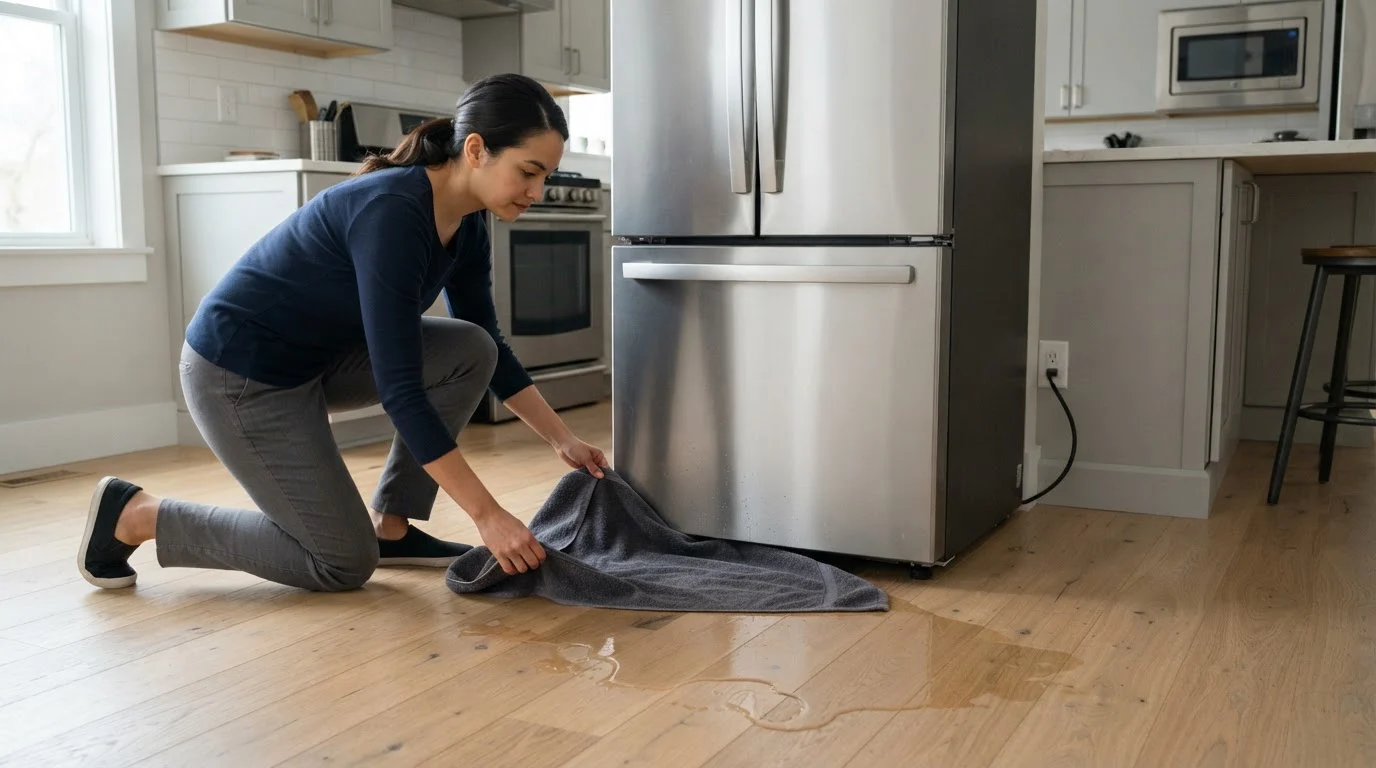
Wipe the area dry, lay down a dry towel, and look again in an hour. If the towel is wet again at the same spot, you have a leak. Note where it first shows up.
If your refrigerator makes ice or dispenses water, a small supply line, plastic or braided metal, runs from the house plumbing to the back of the unit. Over time, fittings loosen, lines get pinched when the refrigerator is slid back, and connections can drip slowly. A slow drip can run down the wall to the baseboard and across to a nearby outlet, which is why leaks near outlets deserve extra attention. Close the supply valve and see whether the leak stops. If it does, you have found the area to describe. Do not tighten fittings hard or swap tubing yourself; a connection repair needs the right parts and a dry, safe setting. For supply-related causes, ice maker cleaning and water supply explains how supply issues show up.
Inside many refrigerators, the cooling system melts frost periodically, and the meltwater runs down a drain tube to a pan. If that tube clogs or freezes, the water backs up and spills into the unit or onto the floor. You may see water under the vegetable drawers, a sheet of ice at the bottom of the freezer, or a puddle at the front. The dE message signals a defrost system that has not completed its work in the past day. If you see frost buildup together with leaking, read frost building up inside a GE freezer. Do not pour hot water into the unit or chip at ice with sharp tools, since you can damage a line or a coil.
If the refrigerator tilts forward or the doors do not swing shut on their own, water can drip from the front. A gasket that is cracked or folded lets in humid air, creating condensation and drips. French-door models such as the GE GNE27JGMWW have a long gasket and more places for moisture to collect. A top-freezer like the GE GTE18MTRRWW has a shorter seal but a drain tube that can freeze. Wipe the gaskets and check that they lie flat.
Many San Francisco kitchens sit above or beside someone else’s home. Water that escapes a refrigerator can travel under flooring and into the ceiling below. If you live in a condo or a building with shared plumbing, tell the building manager when you find a leak you cannot stop, and ask whether the supply line or a neighbor’s unit might be the real source. Photos of the leak and the surrounding area help any later conversation about the cause.
Book a diagnosis if the leak returns after the area is dry, if the water comes from a line or the dispenser, if there is ice in places it should not be, or if food is warming. The visit tells a drain, supply, door or sealed-system problem apart and removes the guesswork. The diagnosis comes first, the estimate is written, and nothing is repaired until you agree. See GE Refrigerator Repair and the GE Refrigerators guide. If you want to be ready, preparing for a refrigerator visit is a short read, and finding your GE model number helps you read out the number when you call.
Not until the area is dry and the source is known. If the outlet is wet, turn off the breaker, keep the doors closed to hold the cold, and arrange a check.
Keep the doors shut and watch the temperature; perishable food should not sit warm for long. Move it to a cooler with ice if the power will be off for several hours.
It can be. A recurring puddle means water is escaping somewhere, even slowly, and a slow leak near electricity or a floor is worth finding.
It can, particularly hardwood and laminate, so stopping the supply and drying the floor promptly matters as much as the repair itself.
Share a few details and we’ll confirm an appointment. Prefer to talk? Call us and we’ll help right away.