Range Hood and Vent Repair in San Francisco
Repair for GE and GE Profile range hoods, over-the-range vents and chimney hoods in San Francisco kitchens.

Specialized GE Appliance Repair in San Francisco
Mon–Sat: 8:00 AM – 7:00 PM
A hood is the one appliance you only notice when it stops working. Learn the types, the numbers and what keeps it moving air.
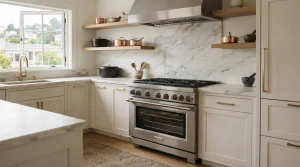
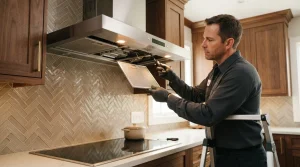
A range hood pulls cooking air, grease and steam away from the cooktop. In a small San Francisco kitchen with no window, it is often the only way to clear a smoky pan. Because it sits above eye level and has no cycle to complete, it rarely gets attention until the fan sounds strained or the light goes dark.
GE’s ventilation line spans two physical styles:
The prefixes on this site are JV, JVW, JVX and PV, with JVX and PVX variants in the line. JV and its variants belong to the GE line, and PV points to GE Profile. Over-the-range microwaves, which also ventilate, carry JVM or PVM numbers and belong in the GE microwaves guide, so do not confuse the two.
Hood numbers follow the same logic as other GE products: the opening letters give the line and product type, digits follow, and trailing letters mark color or finish. Consider JV665CWW. JV marks it as ventilation, 665 points to the feature level and width pack, and WW is white. Its sibling ends in BB, which is black. The same pattern applies to JV535HWW, whose variants end in BB and CC, and to JVX5305SJSS, where SS signals stainless.
Width matters more here than for most appliances. These models are listed at:
A hood should be at least as wide as the cooking surface under it, so check the range width before talking about hoods.
Hood labels are often inside, under the grease filters or on the inner edge of the housing. You usually have to remove the filter to see it, and a photo taken with the filter out saves another trip up the stepladder. Our post on finding your GE model number covers where labels commonly hide.
If you are thinking about swapping a hood, check the width of the cooktop, the height between the cooking surface and the underside of the hood, and where the duct or electrical feed comes out of the wall. Those three measurements decide more than the model name. If the new hood does not line up with the existing opening, the work grows from a swap into a small carpentry job. Bring your current model number to any conversation so the dimensions can be compared against the listing.
This matters more than the model. A ducted hood sends air outside through a duct. A recirculating hood pushes air through a filter and back into the room. Many city condos use recirculating setups because the building does not allow a new duct through the wall or roof. If your building has rules about exterior penetrations, a recirculating hood is probably what you have. Recirculating units rely on a charcoal filter that wears out, and a worn one stops removing odor even when the fan runs.
| What you notice | What to check from outside | What it can mean |
|---|---|---|
| Weak airflow | Grease filters clean, outside damper or vent cap not stuck shut | Clogged filter, blocked duct, worn recirculation filter |
| Fan does not run on any speed | Breaker, switch, is the light also dead | Power, switch or motor |
| Loud rattling or whirring | Loose filters, something in the blower opening | Out-of-balance blower, loose parts |
| Dripping grease | Filters seated, full of grease | Saturated filters |
| Light stays off | Bulb type in the manual, switch position | Bulb or socket |
Our post on a GE range hood with weak airflow, noise or a dead fan covers the full sequence. We have no display codes to list for hoods, so a hood problem is described by what you hear and see rather than by a code.
If your range has a microwave above it, the ventilation fan sits inside that microwave. The care steps are the same: clean the grease filters and clear the vent. Fault codes belong to the microwave and are listed under error codes.
If the fan hums but does not turn, the hood trips a breaker, or cleaning the filters changes nothing, book. Booking brings a diagnosis at your address and a written estimate; you decide whether to proceed. The GE range hood repair page explains the visit, and the GE ranges guide covers the appliance below it.
Repair for GE and GE Profile range hoods, over-the-range vents and chimney hoods in San Francisco kitchens.
Top-control, front-control and pocket-handle GE dishwashers, how the model number reads, and what the C-codes and H2O messages mean.
How GE and GE Profile dryers are sorted by prefix and fuel, what usually goes wrong and how to keep the exhaust…
What separates GE upright frost-free, manual-defrost and chest freezers, how their model numbers read, and the faults each type is prone to.
Two very different ways to get ice from GE: the maker built into a refrigerator and the GE Profile Opal nugget machine…
A guide to GE and GE Profile microwaves: over-the-range, countertop and Advantium, with model prefixes, F codes and care.
A guide to GE and GE Profile ranges, covering electric, gas and induction types, model prefixes, fault codes and care.
Share a few details and we’ll confirm an appointment. Prefer to talk? Call us and we’ll help right away.