

Specialized GE Appliance Repair in San Francisco
Mon–Sat: 8:00 AM – 7:00 PM
From greasy filters to a blocked duct to a motor that will not spin, here is what to look at when your GE hood stops clearing the air.
Ventilation over a cooking surface comes in two main forms. A true range hood or chimney hood is a dedicated unit mounted on the wall or under a cabinet, with its own fan and filters. An over-the-range microwave combines a microwave oven with a smaller vent fan underneath. GE sells both: the hood models found on this site include the GE JV535HWW, the GE JVX5305SJSS and the 36-inch GE JV665CWW, while over-the-range microwave models such as the GE JVM1851WD carry the fan in the same cabinet as the oven.
The difference matters. A hood that ducts outside moves air through a pipe to the exterior. A hood that recirculates passes air through a filter and returns it to the room. Both can lose performance, but for different reasons. The first suffers from blocked ductwork; the second depends heavily on its filters being fresh.
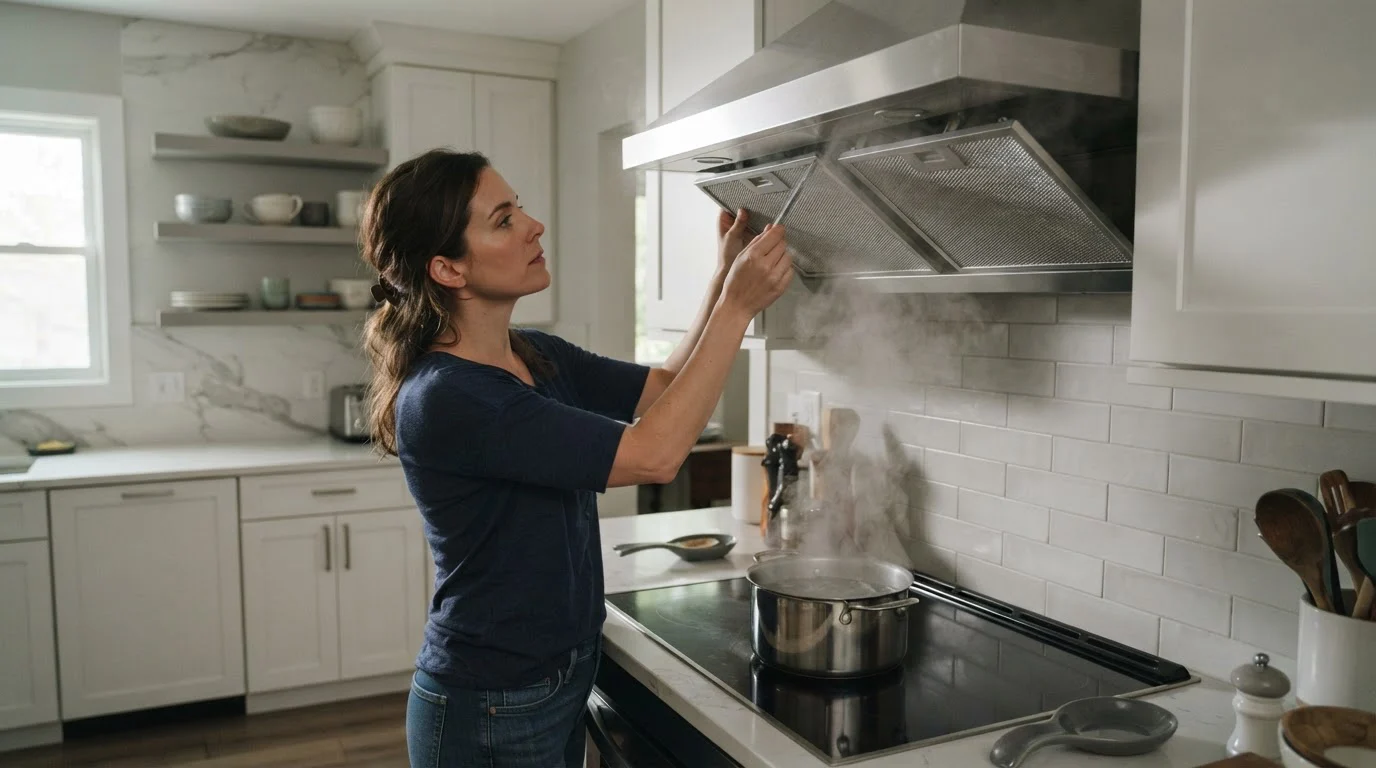
The metal grease filters under or inside the hood are the first thing to look at. A cooking film builds on them slowly and then suddenly reduces airflow. If they look shiny with grease or feel sticky, they are overdue. Most metal filters can be removed by hand and washed in hot soapy water or on a dishwasher rack, but the manual for your model tells you which ones are safe for that. Dry them fully before putting them back.
If your hood uses a charcoal filter for recirculating mode, washing will not restore it. Those filters have a limited life and are replaced as the manual describes. A saturated charcoal filter can make the hood seem weak or let odors drift back into the room.
Check that the filters are seated the right way round and that nothing is hanging in the airflow path. A filter that sits crooked leaves a gap, and the air takes the path of least resistance around it instead of through it.
Hoods that vent outdoors push air through a duct and past a small flap at the outside wall or roof, called a damper. If that flap is stuck shut, packed with lint, grease and bird nesting, or frozen by cold weather in other parts of California, airflow drops sharply. Near the coast the damper can also corrode from salt air.
You can check without tools. With the fan running, go outside to the vent cap. You should feel a steady push of air and see the flap open. If the flap hangs shut, or you see debris, the duct is a prime suspect. In condos and apartment buildings, the outside vent may be on a shared wall or roof where you cannot reach it. In that case, building management is the right contact, since the ductwork belongs to the building.
Long duct runs with many elbows, or flexible foil duct, reduce flow compared with a short straight pipe. A kitchen remodel that changed the hood or moved the stove can leave the ductwork undersized for the new unit. That is a design question rather than a failure, and it is worth mentioning when you call.
| Sound | Safe check | What it can mean |
|---|---|---|
| Rattling at higher speeds | Filters seated, panels closed, nothing loose | Loose filter or trim vibrating; sometimes fan blade imbalance from grease |
| Whistling or roaring | Filters clean, outside damper open | Restricted airflow forcing the motor harder |
| Grinding or scraping | Turn off and listen once the fan has stopped | Motor bearing or fan wheel touching the housing |
| Humming without turning | Try each speed, spin nothing by hand | Motor not starting, a failed capacitor or stuck fan |
| Rhythmic thump | Check for loose filters or duct vibration | Fan wheel out of balance from buildup |
Do not spin the blower with your hand while the unit is connected, and do not reach into the housing. If a sound is a grind or a hum with no movement, switch the fan off at the control and stop using it until it is diagnosed.
Cooking vapor leaves a film on the fan wheel and inside the housing. Over months it adds weight and unbalances the wheel, producing vibration and noise, and it reduces the air moved. Wiping the visible exterior and the underside is fine. Taking the housing apart to degrease the blower is a job to leave for a visit, because it involves opened panels and the electrical connection.
Open-plan kitchens with lots of frying, or kitchens where a wok burner sees heavy use, load the filters faster than light cooking does. Plan on a more frequent wash if you cook that way, and do it before the filters look dirty, not after.
Gather the model number, which is on a label inside the hood or under the filter area, whether the hood vents outdoors or recirculates, which fan speeds work, any sounds, and what has changed recently. Having these ready makes the diagnosis faster. If the model is a combination unit, the guide to GE range hoods and the GE microwave repair page help you sort which service applies.
Book a visit when filters are clean, the outside damper opens, the breaker is fine and airflow is still poor, when the fan makes grinding sounds, or when the fan will not start on any speed. We diagnose in your kitchen, give a written estimate and repair only after you approve. Details are on the GE range hood repair page.
Follow the manual. As a rule of thumb, wash them whenever they feel greasy to the touch, which for regular cooks usually means every month or two and sooner with heavy frying.
Not necessarily. A recirculating hood depends on its charcoal filter, and a ducted one depends on a clear duct. Check the filter type and the outside damper before blaming the motor.
That is a bad idea. A smaller or twistier duct restricts flow and makes the fan louder. The duct size should match the hood connection.
A light rattle from a loose filter is harmless once fixed. A grinding or scraping noise is not; turn the fan off and book a diagnosis.
Share a few details and we’ll confirm an appointment. Prefer to talk? Call us and we’ll help right away.