

Specialized GE Appliance Repair in San Francisco
Mon–Sat: 8:00 AM – 7:00 PM
A GE washer that finishes its cycle with water still in the drum usually has a drain, load or lid issue. Here is what to check safely and when to book.
You open the door, or lift the lid, expecting damp but finished laundry, and instead there is a pool sitting in the drum. Sometimes it is an inch of cloudy water, sometimes the load is half submerged. That is one of the more unsettling ways a washer can end a cycle, but it usually comes down to a short list of causes, and several of them can be separated from the outside without touching anything behind a panel.
Check the display before you do anything else. A washer that stopped on purpose behaves differently from one that simply could not move the water out. On GE washers with the 2017 and newer electronic controls, a few messages matter here:
If the display is blank or shows nothing unusual, you are probably dealing with a drain problem rather than a control message. Write down where in the cycle it stopped: during the wash, after the rinse, or during the spin. That detail narrows things down faster than almost anything else.
A washer has to do two separate things at the end of a cycle: pump the water out, then spin the drum fast enough to throw off what remains in the clothes. Water in the drum means one of those steps did not finish. The reasons fall into a few groups.
| What you see | What to look at from the outside | What it can point to |
|---|---|---|
| Cycle ended, drum full or half full, no message | Drain hose kinks, hose pushed too far into the standpipe, a filter your manual lets owners clean | A restricted drain path or a pump that is not moving water |
| Water left plus a wet, bunched load | Load size, one heavy item such as a bath mat or comforter, washer level | An unbalanced load that stopped the spin |
| Washer paused midway and sat for hours | Display shows CAnCELEd, or the cycle is simply halted | A canceled or interrupted cycle, not a mechanical failure |
| Water level keeps rising or the floor is wet | Supply valves, floor around the washer | A fill problem; shut the valves, then book a visit |
| Combo unit shows 18 or a drain pump filter message | The drain pump filter described in the owner’s manual | A restriction in the drain area |
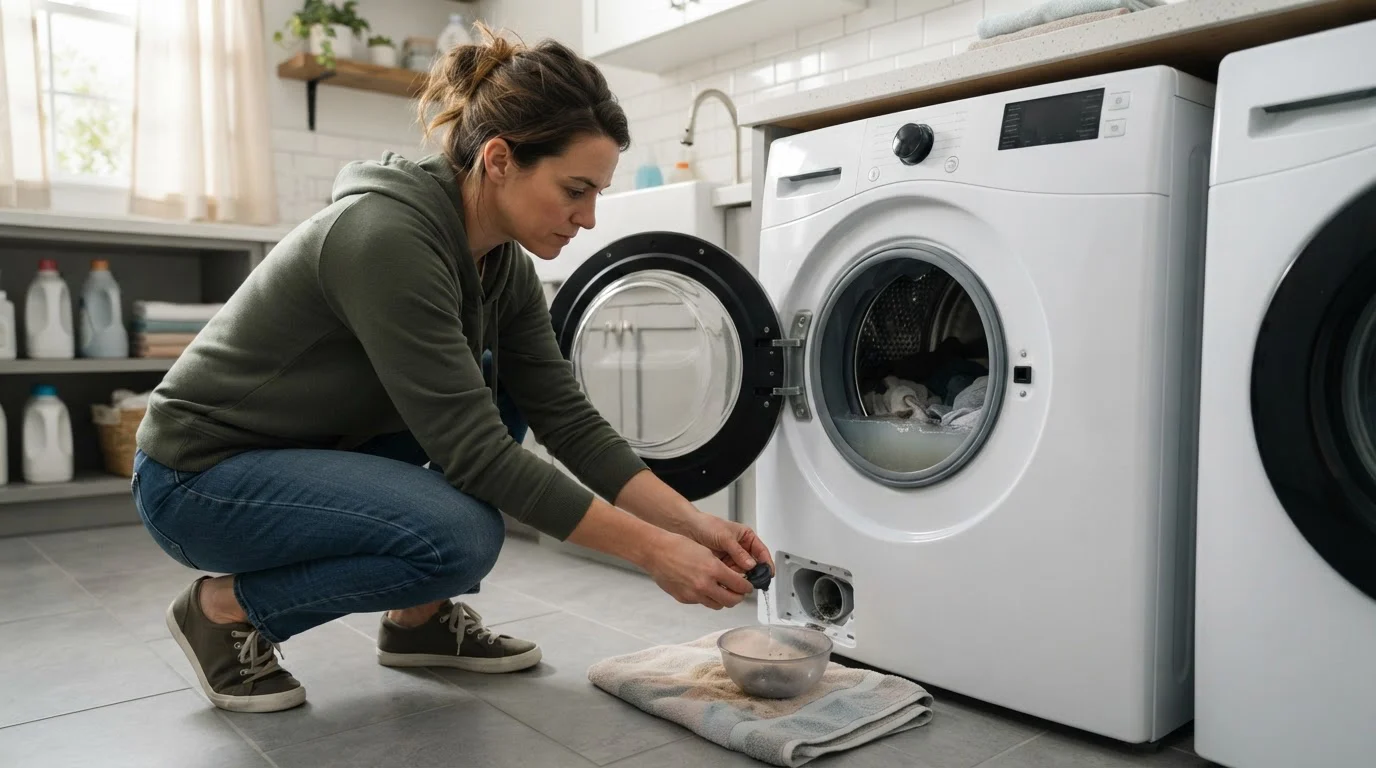
Press Cancel or wait out the lockout, then unplug the washer if you can reach the plug without standing in water. Lay towels on the floor in front of the machine. With a front-loader, water can pour out the moment the door opens, so ease it open over a shallow pan or a stack of towels. Standing water and a live appliance do not mix, which is why the plug comes first.
Pull the washer a few inches forward if there is room, or shine a light behind it. A hose squeezed against the wall, folded over a baseboard, or crushed behind a stacked dryer will drain slowly or not at all. Straighten any kink gently. Also look at where the hose enters the standpipe or the laundry sink. If it is pushed all the way down, water can siphon back and forth and the pump struggles. The hose should hang loosely in the opening, not seal it. In older Bay Area buildings, especially flats where the laundry sits in a closet off a hallway, the standpipe is often barely taller than the hose bend, so this one is worth a careful look.
If the display said UE, or if the clothes are wound into one wet rope, the spin may have been abandoned. Open the door or lid, pull the items apart, and spread them around the drum. Take out the single heaviest item and run the load again. Then confirm the washer sits level and does not rock when you push on a top corner. Plenty of older San Francisco homes have sloping or uneven floors in basements and garages, and a washer that was level on installation day can drift.
Some front-load washers and combination units have a drain pump filter behind a small access door at the bottom front. Where the owner’s manual describes it as an owner task, a clogged filter is a common reason water will not leave. GE publishes this exact situation for the UltraFast Combo: code 18 means the drain pump filter needs cleaning, and it can leave very wet loads and longer drying times. The related messages GE Washer Dryer 18 code and Check and Clean Drain Pump Filter point the same way. Have towels and a shallow dish ready, because the water waiting behind the filter will come out. Coins, hair ties and small socks are the usual finds. If your washer has no such filter in the manual, do not go looking for one behind a panel.
Once the hose is straight, the load is loosened, and any filter is clean, close the door, plug the washer in, and choose the drain and spin option if your model has one. Listen. A pump that hums or gurgles and then pulls the water down is working. A pump that is silent, or that runs loudly with no change in the water level, is telling you the problem is not something you can reach.
In a top-load washer the water sits visibly around the agitator or impeller, and a half-drained tub often means the spin was refused because of the lid, an unbalanced load, or a drain restriction. Models such as the GE GTW540ASPWS and the GE GTW685BPLDG are top-load washers, so lid behavior is part of your checklist. If the lid does not close fully or the display says dE, fix that first.
A front-load washer, such as the GE GFW655SPVDS or the GE GFW850SSNWW, holds its water low in the door opening, so even a small amount that did not drain shows through the glass. These washers also depend on a clean door gasket and a drain pump filter free of debris. If you notice a musty smell along with the standing water, the front-load washer odor and gasket guide covers drying out the drum and gasket care.
There is a difference between water that never drained and water that keeps arriving. If the level rises while the washer sits idle, or if you find water around the base, close both supply valves behind the washer and unplug it. That situation is covered in the guide on a GE washer that keeps filling, overflows or leaks. In an apartment or condo, tell your building contact if water is heading toward a neighbor’s unit, since many Bay Area buildings have rules about laundry water damage.
When these checks do not fix it, the problem sits somewhere you cannot see. A visit sorts it into a few possibilities: a blocked or failing drain pump, a restriction deeper in the drain path, a pressure sensor that misreads the water level, a door or lid lock that will not release, or a motor and control issue that stops the spin. Each leads to a different repair, which is why the diagnosis comes first, the estimate arrives in writing, and nothing is touched until you approve it. You can read about the GE Washer Repair service, or start with the GE Washers guide to see how top-load, front-load and combo units differ.
To make the visit productive, have the model number ready, note the display message, and mention at what point in the cycle the water stayed behind. The guide to describing a GE washer problem lists what is worth writing down. If you cannot find the model label, see finding your GE model number.
One drain-and-spin attempt after clearing the obvious causes is reasonable. If water stays, or the display shows FE, stop, close the supply valves and unplug the washer. Repeated restarts can overfill the drum or burn out a pump.
Yes, with a cup and a bucket or towels, once the washer is unplugged. Do it to rescue the clothes and protect your floor, then leave the diagnosis for later.
Large or heavy items soak up water and throw the drum off balance, so the washer refuses to spin and leaves water behind. Washing bulky items on their own and spreading the load evenly often removes the problem.
Slow draining is still a drain restriction. Water that seeps away overnight points to a partial blockage or a sluggish pump, and it tends to get worse. Book before it turns into a full stop.
Share a few details and we’ll confirm an appointment. Prefer to talk? Call us and we’ll help right away.