Wine Coolers and Beverage Centers
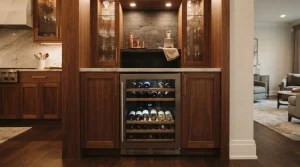
GE wine centers and beverage centers keep bottles and cans at a steady temperature. Here is how they differ and what keeps…

Specialized GE Appliance Repair in San Francisco
Mon–Sat: 8:00 AM – 7:00 PM
A wine cooler that drifts warm, runs constantly or sweats inside needs a careful look. We diagnose GE wine and beverage centers at your home.
A refrigerator can run a little warm for a week and the leftovers will survive. A wine cooler that drifts is a different matter, because the bottles inside are often the whole reason you bought it. Collectors in Pacific Heights and Noe Valley, couples with a few dozen bottles in a Marina flat, and families who keep a beverage center in the garage or at the bar all ask us the same thing in different words: why is it not holding steady anymore?
We repair GE and GE Profile wine coolers and beverage centers in San Francisco and nearby. Each job opens with a diagnosis where the cooler stands, followed by a written estimate and a repair only if you sign off. Arrange it through the contact page or by phone.
The prefixes sort the range. Wine centers carry GWS or GWR on the label, beverage centers carry GVS, and the GE Profile equivalents begin PWS, PWR or PVS. The first letters of the model number tell you which family you own, and the digits that follow separate sizes and features. Our models list includes the GWS03ADWSS, GWS04HAESS and GWR03AAMBB.
The distinction is useful because a wine center is built to hold a narrow range for bottles lying on racks, while a beverage center is closer to a refrigerator for cans and bottles at serving temperature. If you want to read more about the lineup, the GE wine cooler and beverage center guide breaks it down by prefix.
| You notice | Look at | A visit may find |
|---|---|---|
| Bottles feel warmer than the display says | How full the unit is, where the sensor sits, how recently the door was opened | A control that reads wrongly, or a unit that cannot keep up. See GE wine cooler or beverage center temperature drifting. |
| Runs without stopping | Ventilation around the cabinet, dust on the grille, a door that is slightly ajar | Heat that has nowhere to go, a seal problem, or a cooling fault |
| Condensation or drips inside | Door gasket, how often the door is opened in humid weather | A leaking seal, a blocked drain or a ventilation issue |
| Display dark, no fan sound | Outlet, GFCI, breaker, plug fit under the counter | Power problem versus a failed control |
| Rattling or humming | Is it level? Is it touching cabinetry on a side? | Vibration from install or a fan that needs attention |
| Lights out | Whether other functions work | A lighting part or a control board issue |
| Bottles feel cold at the back, warm in front | Air gaps behind the racks | An airflow problem inside the cabinet |
Please do not move a loaded wine cooler to another room to test it. Disturbing bottles and rapid temperature changes are the opposite of what you want, and a loaded cabinet is heavy. Do not remove back or bottom covers either.
A Victorian flat with an old kitchen may have a built-in cooler under a counter with almost no clearance. That is an easy home for dust and a poor home for heat. A garage unit can feel the whole range of Bay Area weather, from cool, foggy mornings near the ocean to a warm afternoon in a South Bay house. Coolers in dining rooms or bars face the opposite issue: sun through a window. Salt air near the coast can also dull the hardware over time. When you call, tell us where the cooler is and whether it is built in or freestanding, because that decides how we plan the visit.
Some models have a display and may flash an indicator when something is wrong. There is no published code list for these coolers that we can quote to you. What helps most is writing down exactly what the display shows, along with the temperature setting and the time you noticed it. Photograph the display if you can. For error codes on other GE appliances, the error codes page is the place to look.
When a wine cooler goes wrong, the question is rarely just “is it broken?” It is “is it making cold, is it keeping cold, and is it measuring cold correctly?” Those are three different problems. A cooler that makes cold but cannot keep it often has a seal or ventilation issue. One that never makes cold has a cooling-side or power fault. One that makes and keeps cold but reads wrong needs its sensing looked at. On the visit we work through them in that order, tell you what we found, and put a written estimate in your hands. You decide whether we go ahead.
If you have a larger decision in mind, such as whether the unit is worth repairing, read repair or replace a GE appliance first. We are happy to give you the diagnosis either way.
If the cooler is clearly warm, or the temperature keeps climbing, move the bottles you care most about to a cool, dark spot in the house while you wait, away from sunlight and the oven. If you see water pooling beneath the cooler, smell something burning or find the cord hot, unplug it. Do not use the unit until it has been examined. If bottles have already been through a hot spell, do not assume they are ruined, but keep the special ones aside until you can taste them.
The label usually sits on an inside wall, the ceiling of the cabinet, or the door frame. Built-in coolers may need the bottom rack pulled out to see it. Take a clear photo with your phone. Our guide to model and serial labels lists spots on other appliances, which helps if you are sorting several at once.
You book, we ask about the symptom and the setting, and then we arrive and look at the cooler where it stands. Building rules in condos or high-rises, such as elevator reservations, are good to mention up front. After the diagnosis we explain the cause, give you a written estimate and wait. You can check whether we cover your block on the San Francisco page or in the full list of areas.
It is built to hold a steadier, gentler temperature and to store bottles on their sides. A mini refrigerator is not designed for that.
Wiping the gasket with mild soap and water is fine. If it is torn or has lost its shape, a technician should look at it.
Yes, though we may need to slide it out. Clear the area in front and tell us if the opening is tight.
Yes. See GE refrigerator repair for the full-size units.
GE wine centers and beverage centers keep bottles and cans at a steady temperature. Here is how they differ and what keeps…
Repair for GE and GE Profile dishwashers that will not drain, fill, clean or start, across San Francisco and the Bay Area.
Repair for gas and electric GE dryers across the city and the Bay, starting with a look at your vent and a…
Repair for GE upright and chest freezers in garages and kitchens around San Francisco and the Bay Area.
Repair for ice makers built into GE refrigerators and for GE Profile Opal countertop nugget ice makers in San Francisco and the…
GE microwaves of every kind, from over-the-range to Advantium, checked at your home with a written quote ahead of repair.
GE ranges and cooktops, electric, gas or induction, examined at home and priced in writing before work starts.
Share a few details and we’ll confirm an appointment. Prefer to talk? Call us and we’ll help right away.