Dishwashers
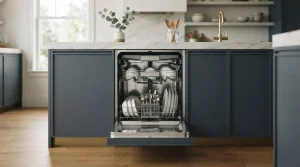
Top-control, front-control and pocket-handle GE dishwashers, how the model number reads, and what the C-codes and H2O messages mean.

Specialized GE Appliance Repair in San Francisco
Mon–Sat: 8:00 AM – 7:00 PM
Standing water, a C-code, leaks or dishes that come out dirty: we diagnose GE and GE Profile dishwashers in your home and explain the repair first.
Dishwashers fail in loud, obvious ways. The cycle ends with an inch of gray water in the tub. A beep keeps sounding and a letter-and-number code sits on the display. Dishes come out with a film that was not there last month. We repair GE and GE Profile dishwashers in San Francisco and around the Bay Area, and the work always starts with the same question: is the machine failing, or is something around it, like the drain, the water supply or the way it is loaded?
Our sequence is fixed: find the cause in your kitchen, write the estimate, and fix it only once you agree. The contact page or a phone call gets you on the schedule.
The model number says a lot. GDT is a GE top-control dishwasher, GDF is front-control and GDP has a pocket handle. GE Profile versions start with PDT or PDP. Top-control models hide their buttons along the top edge of the door, which keeps them out of sight but exposes them to splashes when the door is open. Front-control and pocket-handle models put the display on the door face.
Our model list includes the GDT655SMJES, GDT665SFNDS, GDT226SSLSS and GDT630PGMWW top-control units; the GDF550PGRWW, GDF465PGZWW and GDF535PSRSS front-control units; and the GDP630PGRWW with a pocket handle. The GE dishwasher guide covers how to read the number.
| What happens | What you can look at | What a diagnosis separates |
|---|---|---|
| Water left in the bottom after the cycle | Filter debris, a kinked or low-hung drain hose, the garbage disposal knockout, the air gap | A blocked path versus a pump that is not clearing water. See the post on water on the floor for the leak side. |
| Will not fill or starts and stops | Hot water valve under the sink, a kinked inlet line, whether the machine is level | A supply restriction versus a fill valve or float issue |
| Does not start at all | Door fully latched, breaker, whether a code is showing | A latch, a control or a power-side issue |
| Dishes still dirty or gritty | Filter cleaned, spray arms spinning freely, detergent cup, loading | A clog in the circulation path or a detergent cup that does not open |
| Water on the floor | Which side? Door gasket, supply and drain connections under the sink | A door seal, a fitting, or an internal leak |
| Musty smell | Food trapped in the filter or drain trap | Standing water pointing to a drain problem |
| Loud grinding or humming | Something small, like a broken glass fragment or a bottle cap, in the filter area | An object in the pump versus a worn pump |
Do not remove the lower front panel, pull the unit out by its hoses, or put a hand into the drain opening. Those are jobs for a technician with the power off.
GE dishwashers show codes starting with C, plus a few word-style messages. The ones with verified meanings each have their own page:
If a code does not clear after the owner step, stop retrying and book. Repeated restarts can leave water in the tub, and a leak code in particular should not be tested again and again.
Most dishwasher calls come down to water in, water out, heat, or control. A fill problem and a drain problem look different from the inside, even when both end with a machine that quits. Cleaning problems tend to turn out to be circulation: a spray arm blocked, a filter packed or a pump that has lost pressure. We work through these in order, tell you which one it is, and write the estimate. Nothing is repaired without your approval. For borderline cases, repair or replace a GE appliance helps you think it through.
The simplest prevention is in filter cleaning, loading habits and drain care, which also explains why rinsing plates matters less than you might think and why overloading matters more.
Water runs harder in several East Bay and South Bay communities, and it leaves a film on glassware and scale on heating surfaces faster than San Francisco’s softer supply does. If your dishes look cloudy and you are in one of those places, mention it when you book. San Francisco’s older flats bring their own quirks: dishwashers installed in tight alcoves with a short drain run, a supply valve that has not been turned in years, and kitchens where the only access to plumbing is behind a cabinet. In condos, a leak is a shared problem, so building rules about water shut-off often apply.
Stop and call if water pools on the floor, a LEAK DETECTED or 999 message appears with a puddle, you smell something burning, or the door will not close properly. Shut off the water supply under the sink and the breaker if water is moving toward an outlet. A dishwasher full of standing water should not be run again until the drain problem is understood.
On most GE dishwashers the label is on the tub edge or door inner panel, visible when the door is open. Take a photo. If you struggle to find it, the guide on locating model and serial numbers starts with dishwashers. Have the code, what you tried and when it started ready when you call.
We start by asking what the machine did last, then examine the tub, the door and the connections under the sink. We explain the finding in plain terms, provide a written estimate and wait. You can see our service areas on the San Francisco page and the locations list.
Some codes clear with a simple reset; others cancel the cycle. If it comes back, wait for a visit.
No. Debris, a bent hose, the disposer knockout or an air gap can cause it too, which is why we check them first.
Look at spray arms, detergent cup and water temperature. The C6 and C8 codes cover two of those.
Yes, both lines.
Top-control, front-control and pocket-handle GE dishwashers, how the model number reads, and what the C-codes and H2O messages mean.
Repair for gas and electric GE dryers across the city and the Bay, starting with a look at your vent and a…
Repair for GE upright and chest freezers in garages and kitchens around San Francisco and the Bay Area.
Repair for ice makers built into GE refrigerators and for GE Profile Opal countertop nugget ice makers in San Francisco and the…
GE microwaves of every kind, from over-the-range to Advantium, checked at your home with a written quote ahead of repair.
GE ranges and cooktops, electric, gas or induction, examined at home and priced in writing before work starts.
Repair for GE and GE Profile range hoods, over-the-range vents and chimney hoods in San Francisco kitchens.
Share a few details and we’ll confirm an appointment. Prefer to talk? Call us and we’ll help right away.