

Specialized GE Appliance Repair in San Francisco
Mon–Sat: 8:00 AM – 7:00 PM
Find where the water is coming from, which checks are safe to do yourself, and when to shut the dishwasher off and book a diagnosis.
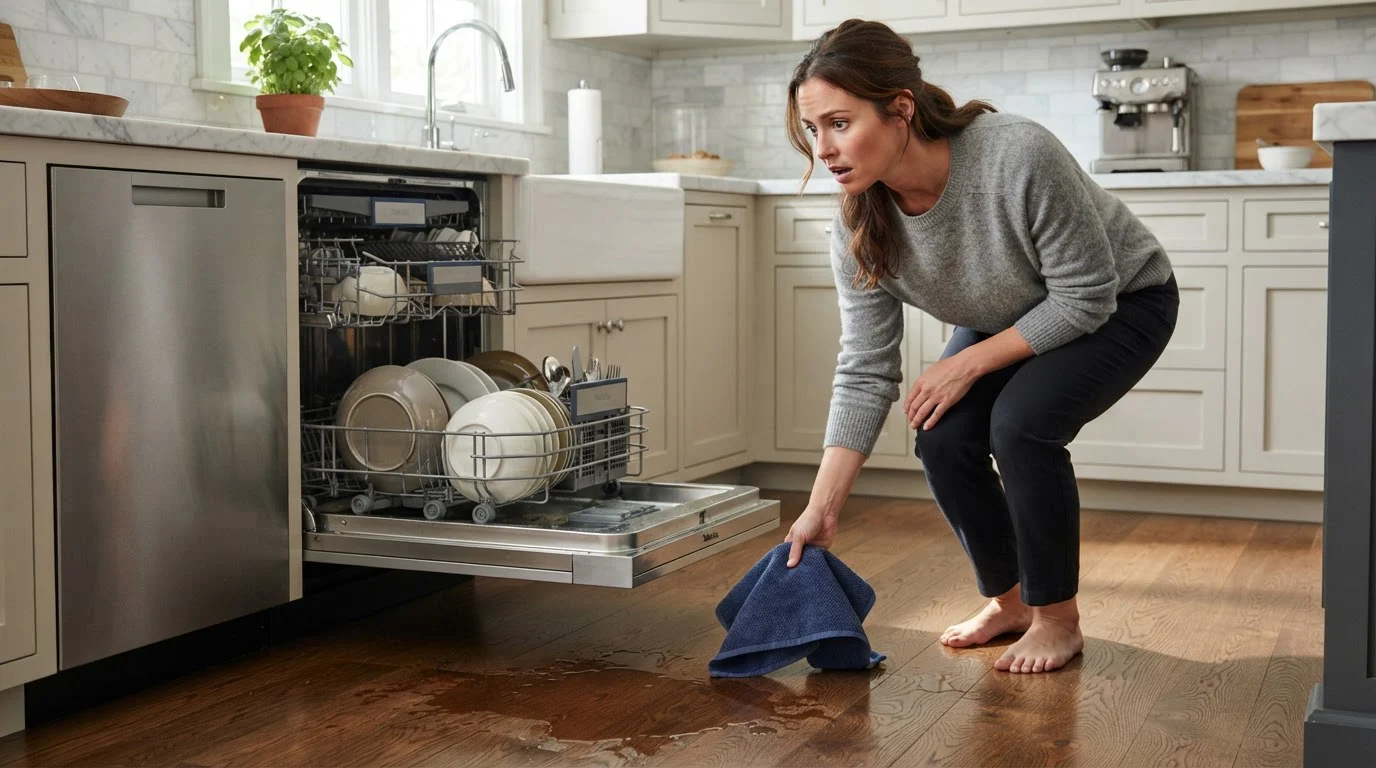
A wet patch in front of the dishwasher is one of those problems that looks like a single event and turns out to have half a dozen possible origins. The puddle itself says very little. What helps is the pattern around it: when it appears, how much there is, and whether it shows up on every cycle or only some. Before you reach for a towel and call it a day, spend a few minutes reading the clues, because a slow leak under a cabinet can soften a subfloor long before anyone notices a puddle.
First, stop the machine. Cancel the cycle, switch off the dishwasher’s breaker if the floor is wet enough to reach the outlet or the power cord under the sink, and mop up. Then run your hand along the bottom edge of the door and the base of the tub front. Dry floor with a damp door edge points in a different direction than a puddle that is clearly spreading from under the toe-kick.
Dishwashers move water in three stages: filling from the supply line, spraying and heating inside the tub, and pumping the dirty water out through the drain hose. A leak in the front of the machine usually belongs to one of those stages, and the timing tells you which.
| When the water appears | What to look at | What it can point to |
|---|---|---|
| Right after the door is opened mid-cycle | Spray arms, loading, tub interior | Normal spill from the spray; a blocked or misaimed arm throwing water at the door |
| During the first few minutes of a cycle | Door gasket, supply connection under the sink | A worn or dirty door seal, or a loose inlet fitting |
| Near the end, during pump-out | Drain hose, air gap, disposer connection | A kinked, loose or clogged drain path pushing water back |
| Only after a long, heavily sudsy wash | Detergent type and amount | Too much foam escaping around the door |
| Even when the machine is idle | Supply valve and the line leading to the dishwasher | A slow drip that is not a dishwasher problem at all |
Keep these to things you can see and handle without opening a panel or tools. Work in this order, because the earlier items are the cheapest to rule out.
Many GE dishwashers show something when water is where it should not be. On models with leak detection, a GE Dishwasher LEAK DETECTED code means a possible leak was sensed and the cycle is cancelled. Treat that as a signal to stop using the machine, not a message to clear and ignore.
Some Floor Protect with Alert models show GE Dishwasher 999 code when a possible leak has been detected and the machine will not start. On the specific models GE lists, holding Cycle Select and Start together for five seconds clears a control that needs a reset. If the dishwasher then fills and the floor gets wet again, the reset did not fix a leak, it only cleared the message.
If the puddle shows up along with a drain complaint, the codes GE Dishwasher C1 code, GE Dishwasher C3 code and GE Dishwasher FTD / F56 code all describe water that is not leaving the tub properly. Standing water in the bottom of the tub after a cycle plus a wet floor suggests the drain path is backing up. The GE Dishwasher H2O code goes the other way: it points to too little water during fill, which does not usually flood a floor, but it can show up alongside a kinked inlet hose.
If the floor is wet only directly in front of the door, and the tub drains normally, the door seal and the loading are the first suspects. Overloading and spray-arm blockage cause more of these than failed parts. A seal that is cracked or hardened lets water by on every run, and that is a replacement job, not a cleaning one.
If you find moisture on the toe-kick panel, under the front of the cabinet, or the floor is wet but the door edge is dry, the leak is inside or below the machine. Candidates include the inlet valve, a hose clamp, the pump seal or a cracked hose. None of these are owner jobs. Pulling a dishwasher out of a kitchen with tile or hardwood risks scratching the floor and kinking the lines, so this is where a diagnosis earns its keep.
A thin line of water along the front edge after each wash usually comes from steam condensing or from a small door-seal gap. In older San Francisco kitchens with wood floors and lower cabinets that are rarely ventilated, even a small recurring amount matters, because the moisture stays trapped. If you can see the dampness on a paper towel after each run, do not wait for it to get worse.
If the area gets wet while the machine is idle, the dishwasher may be innocent. A leaking sink drain, a faucet supply or the dishwasher’s own supply valve can drip constantly. Slide a dry towel under the sink basin, and note whether the drip is steady or only when the sink is in use. The bigger risk in condo buildings is a leak that runs down into a unit below, so tell your building manager if you suspect a shared line.
Stop running the dishwasher and shut off its supply valve if any of these are true: water keeps appearing on every cycle, you see water below the machine rather than at the door, the floor is soft or lifting, or a leak code appears. Switch off the breaker if water has reached the power connection. Running a leaking dishwasher to see if it behaves can turn a small repair into flooring damage that costs far more attention than the original problem.
When you book, the details that save time are the full model number, usually found on a label along the door edge or inside the tub, the code on the display if one appears, and whether the water shows up at the start, middle or end of the cycle. Finding your GE model number walks through label locations. If you already know the model, the matching page, such as GE GDT665SFNDS or GE GDF535PSRSS, lists what to have ready.
A visit begins with diagnosis. The technician traces the water to its source, gives you a written estimate, and repairs only after you approve. For the full picture of what is covered, see GE Dishwasher Repair, and for habits that prevent many of these leaks, read dishwasher filter and loading habits.
A few drops when you open the door right after a cycle is normal. Pools, repeated puddles or a floor that is wet again the next day are not.
You can wipe and inspect it, which is worth doing. Replacing it correctly means seating it fully without twisting, and a leak that comes from somewhere other than the seal will continue, so find the source before buying anything.
New cabinets, a new countertop or a new disposer often change how the drain hose and supply line are routed. Look for a hose that is now kinked behind the unit, a missing high loop in the drain line, or a disposer plug that was left in place.
It is better not to. Small leaks hide under cabinets, and water that reaches the electrical connection or the subfloor creates a bigger problem than the dishwasher itself.
Share a few details and we’ll confirm an appointment. Prefer to talk? Call us and we’ll help right away.